LOCUS SONUS LAB | project coordination : Peter Sinclair | France | petesinc@nujus.net | LOCUSONUS.ORG |
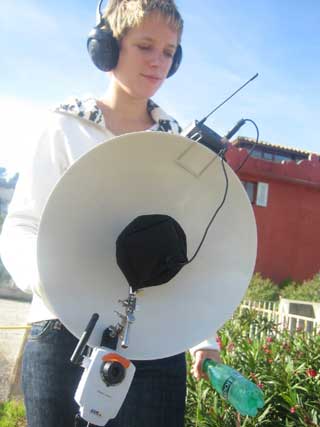
BACKGROUNDLocus Sonus is a research group specialized in audio art, as such it is officially recognized and receives funding from the French Ministry for culture. It is organized as a post graduate course by the Art Schools of Aix-en-Provence (Ecole Superieure d'Art d'Aix-en- Provence) and Nice (Ecole Nationale Superieure d'Art Villa Arson Nice), France. Over the last 18 months the Locus Sonus Lab has been focusing on a process which revolves around a network of audio streams. The audio source for each stream is simply an open microphone which continually uploads chosen soundscapes or sound environments, as playable material. We have now established a worldwide community of streamers each person being responsible for the installation and
|
   |
DESCRIPTION OF THE PROJECTS CORE CONCEPT
|
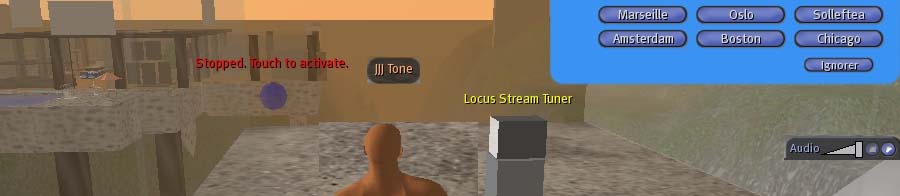 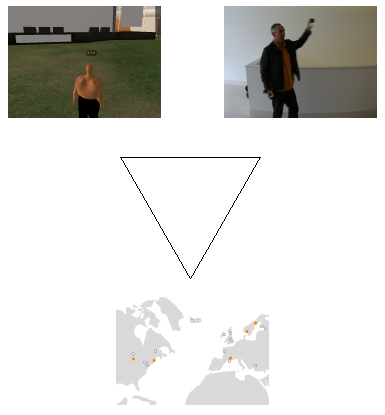 |
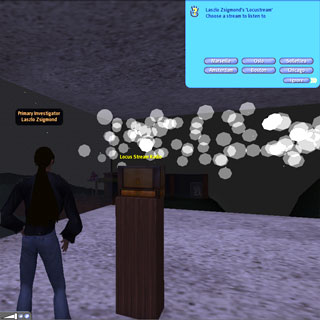
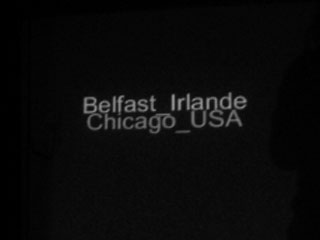
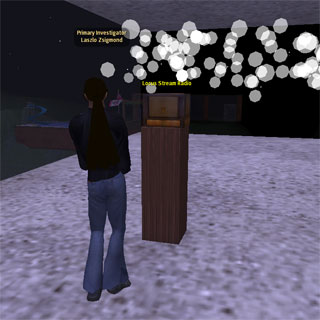
DETAILS OF HOW THE PROJECT WILL BE REALIZEDAudio capabilities in Second Life are relatively limited, beyond spatialization and file playback there is little else, certainly no possibility for sound synthesis or serious audio manipulation. We are currently working in collaboration with SAIC (School of Arts Institute Chicago) to develop an audio server using Super Collider The basic concept would be - URL requests sent from SL as PHP commands -> PHP to OSC -> to audio engine (SC/Max/PD) -> Icecast/OGG -> SL streaming + installation streaming. The generated audio signal will be experienced within the virtual space but also in the physical world (being presented alongside our open microphones for example). We are already familiar streaming techniques and have access to a server with no limits on bandwidth. Custom streaming software will be built using PureData. The decor representing the second life environment will be printed onto plastic canvas then stretched on frames.
|
 |

LOCUS SONUS IN SECOND LIFE | BUDGET
|
   |
|||||||||||||||||||||||||||||||||||||||||||||||||||||||||||||||||||||||||||||||||||||||||||||||||||||||||||||||||||||||||||

EXAMPLES OF PRIOR WORK
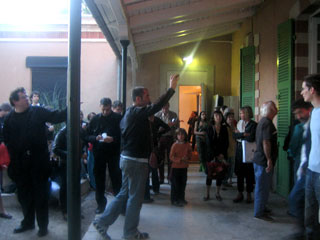
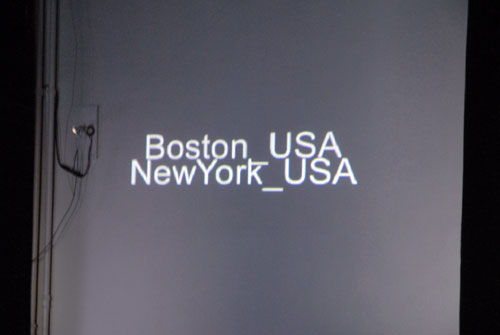
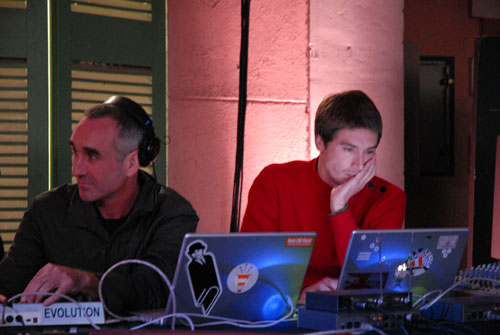
THE LOCUSTREAM PROJECT | 2005...In the fall of 2005 The lab started work on a group project with the aiming to involve the various different members of the group in a way, loose enough, to not stifle indvidual creativity, while still providing a firm basis for comunal experimentation and exploration. Locus sonus is inherently nomadic in nature, shared between 2 institutions separated by several hundred Kms, we travel regularly to meet and work together in and from different locations. After setting a first permanent stream (outside Cap15 a artists studio complex in Marseille) we started by using the stream in a perfomance / improvisation type mode using the, now standard, laptop and MIDI controller with homemade patches to reinterprate the stream in real time. This proved to be somewhat problemetique because often nothing in particular would be happening on the stream at a given time when we were intending to work with it. This led us to follow various leads: Other developments included an activity developed by one member of the group (Nicolas Bralet) which he calls "mémoires de stream" . It consists of listening to the streams on a regular basis from where ever he happens to be at the time and producing a short composition using a mixture of sounds gleaned from the stream and those of the local environment, simultaneously a idealised projection of the remote site and a reflection on the schizophonic* aspects of the whole project. Our main efforts have gone into the development of a spatial form proposing a suitable interpretation of the streams in the local environment. The first attempts involved using resonating wires - long piano wires strung from wall to wall were set into vibration using piezo transducers at one end the resulting modified sound being captured at the other end using guitar pickups. This set up allowed us to perform the streams by touching the piano wires and thus modifying their resonant qualities. Using a I/O board we increased the effect by detecting when a specific wire was touched and increasing the amplitude of the audio signal in that wire. By this time we had three streams up and running (Marseille, Aix en Provence and Chicago) in this first version we used the wires to map out the virtual network, pointing the wire in the direction corresponding to it's provenance with an angle that represented relative distance. A discussion that followed this presentation led us to believe that it was necessary to define the protocol (sound capture/network/local form) that we were employing more precisely. One of our problems was the choice of the stream emplacement - should this be made in relation to geographical location or sound quality or some kind of political or social situation... The decision was made to leave this up to other people, a partly pratical and partly idealogical choice. At this point we tidied up our Pure Data streaming patch so that other people could implement it without too much difficulty, boosted the number of streams which could be accepted simultaneously by our server, and started stripping down our ideas for installations, confident that the worldwide audio art community (with a little help from our friends) would respond to our call, which they did.
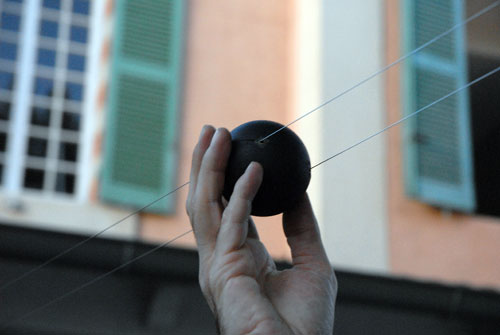
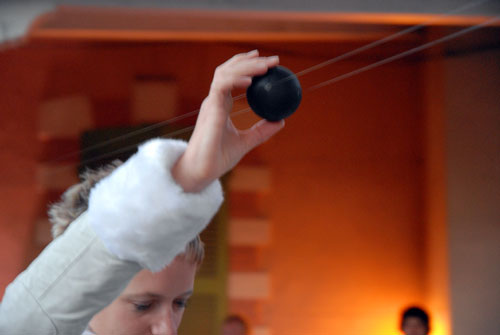
LOCUSTREAM TUNERIn its present version, the installation with which we present the streaming project, consists of a pair of wires stretched the length of the exhibition space with a small ball threaded on them. The position of the ball can be altered by the public acting like a tuner, an audio promenade where users slide their way through a series of remote audio locations. Mutiple loudspeakers enable us to spatialise the sound of the streams creating so that each different audio stream selected on the wire emanates from a new position in the local space.
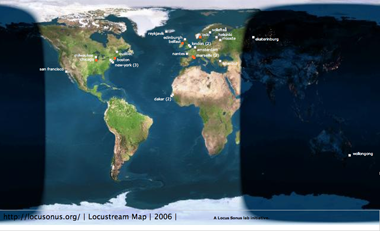
LOCUSTREAM MAPAt one point it seemed necessary to provide the "streamers" (as we have come to call the musicians and artists who've responded to our call) with the possibility to access the streams themselves, not only to hear their own stream but also those provided by other people. Our website now offers an animated map which shows the location of all the streams and indicates those which are currently active with a blinking light. By clicking on a chosen location one can directly listen to the OGG Vorbis stream in a browser.
|
       |